What's Inside the Spice Box: How Sindhi Families in America Are Passing Down Memory, One Aroma at a Time
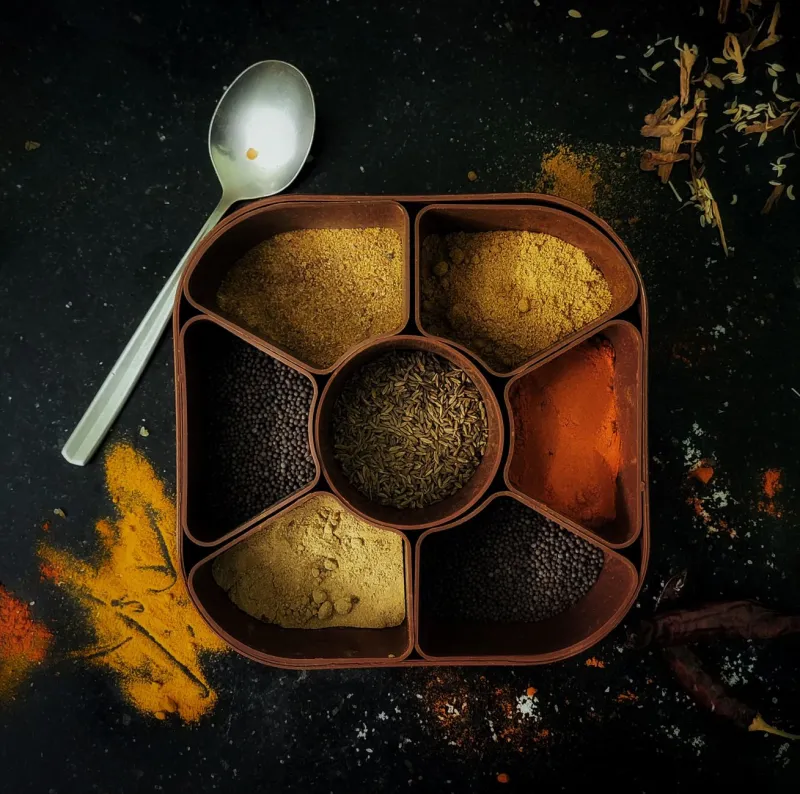
Rohan Mirchandani grew up in New Jersey, and his earliest food memory isn't a dish. It's a smell. Every Sunday morning, his grandmother would open her masala dabba—a round stainless steel box divided into seven smaller compartments—and the kitchen would shift. Cumin, coriander, dried red chili, turmeric. To Rohan, now 34 and living in Chicago, that smell still means home, even though the home it points to is one he never actually lived in.
"She'd grown up in Hyderabad, Sindh," he says, referring to the city in what is now Pakistan. "She never talked much about it. But when she cooked, something changed in her. The spices were the only way I ever really understood what she'd left behind."
This is the quiet power of the Sindhi spice box. It holds flavors. But it also holds history.
The Box Itself
The masala dabba—literally "spice container"—is common across South Asian cooking traditions, but in Sindhi households it takes on a particular weight. Sindhi families were among the most dramatically displaced communities of the 20th century, forced to flee Sindh during the 1947 Partition of British India with little more than they could carry. Food traditions, recipes, and the knowledge of which spices to use and how became some of the most portable pieces of cultural identity they had.
For families who eventually settled in the United States—many arriving in the 1970s and 1980s through professional immigration pathways—those spice habits came along. And the boxes that sit in Sindhi-American kitchens in Houston, New Jersey, California, and beyond are often direct descendants of the ones that made it across the border decades ago.
Priya Vaswani, a food writer and third-generation Sindhi-American based in the Bay Area, describes her mother's masala dabba as "the most loaded object in the house. More than photographs. More than jewelry. The spices are what connect us to something living—because you use them. You smell them. They're not stored away."
Spices as Vocabulary
Ask any Sindhi-American cook which spice most immediately transports them, and you'll get answers that are specific in a way that surprises outsiders.
For some, it's amchur—dried mango powder—with its sharp, fruity sourness that shows up in Sindhi cooking in ways it simply doesn't in other South Asian traditions. "My nani put amchur in everything," says Seema Lulla, a home cook in Dallas. "Dal, vegetables, even the chutney. When I smell it now, I'm eight years old and sitting at her kitchen table."
For others, it's the combination of ajwain (carom seeds) and dried red chilies—a pairing so distinctive to Sindhi snack cooking that it functions almost like a signature. Karan Advani, a software engineer in Seattle who learned to cook from his father, describes the smell of ajwain hitting hot oil as "the most Sindhi thing I know. It's the smell of my dad on a Saturday morning making koki."
These aren't abstract nostalgic associations. They're sensory anchors—specific enough to locate a person in a time and place that might otherwise be slipping away.
What Gets Adapted, What Stays Fixed
One of the more nuanced conversations happening in Sindhi-American kitchens is about adaptation. Which parts of the spice tradition stay exactly as inherited, and which evolve?
For most families, the core spice combinations remain largely unchanged. The specific ratio of coriander to cumin in a curry base, the insistence on whole spices bloomed in oil before anything else is added, the use of tamarind or amchur for sourness rather than lemon—these feel non-negotiable to cooks who learned from parents and grandparents.
What shifts is sourcing and supplementation. Sindhi spices that were once only available at specialty Indian grocery stores—asafoetida (hing), dried kokum, black salt—are now increasingly available on Amazon or at Whole Foods, which means younger cooks are more likely to use them regularly rather than rationing a container bought on a once-a-year trip to a South Asian market.
"My grandmother used to be so careful with hing," laughs Priya Vaswani. "It was precious. Now I can order it in two days. But I still use it the way she did—just a tiny pinch, right at the start. Some things you don't mess with."
Teaching the Next Generation
Perhaps the most urgent conversation in Sindhi-American households is about transmission. How do you pass down a spice tradition—inherently sensory, inherently experiential—to kids who are growing up in a food culture of chicken nuggets and TikTok recipes?
The answers vary, but a common thread is intentionality. Parents who are actively working to preserve Sindhi food culture aren't just cooking Sindhi dishes—they're narrating the process. Explaining why this spice goes in now and not later. Telling the story of where a particular combination comes from. Connecting a flavor to a person.
Seema Lulla has started what she calls "spice Saturdays" with her two daughters. "We open the dabba and I make them smell each one separately. Then I tell them something about the person I associate it with. My grandmother, my aunts. It's become a ritual. They ask for it now."
Rohan Mirchandani recently bought his own masala dabba—his first—and filled it the way his grandmother would have. "I'm not a great cook," he admits. "But I know what goes in the box. And honestly, that feels like enough for now."
The Box Keeps Opening
Sindhi food culture has always been about carrying something forward under difficult circumstances. The spice box is a perfect symbol of that: small enough to travel with, resilient enough to survive displacement, powerful enough to reconstruct a sense of home in an entirely new place.
For Sindhi-Americans navigating the familiar immigrant tension between assimilation and preservation, the masala dabba offers something quietly radical. It says: you don't have to choose between here and there. You can keep both alive in the same kitchen, in the same pot, in the same handful of spices that smell like someone you loved.
That's not a small thing. That's everything.